# High vs low ratio
**URL:** https://foil.zone/t/high-vs-low-ratio/15154
**Category:** Build, Repair & Mod
**Created:** [February 15, 2022, 8:18am UTC](https://foil.zone/t/high-vs-low-ratio/15154 "2022-02-15T08:18:21Z")
**Posts on this page:** 6
**Page:** 1
### Author:  [@Olivianb](https://foil.zone/u/Olivianb)
#### Post date: [February 15, 2022, 8:18am UTC](https://foil.zone/t/high-vs-low-ratio/15154/1 "2022-02-15T08:18:22Z")
I am doing an experiment in school were I will build two different foil wings and then test their lift in water. The idea is that I will be testing one high aspect wing and one low aspect wing. However I am not sure of the messurements, do you have any idea about how big the aspect difference should be? Or how the wings should look to get the best results? (The purpose is the get different results with the different wings so it does not matter if one of them preforms better)
---
### Author:  [@Toto44](https://foil.zone/u/Toto44)
#### Post date: [February 15, 2022, 10:14am UTC](https://foil.zone/t/high-vs-low-ratio/15154/2 "2022-02-15T10:14:59Z")
will these 2 wings have the same surface area?
---
### Author:  [@Olivianb](https://foil.zone/u/Olivianb)
#### Post date: [February 15, 2022, 10:20am UTC](https://foil.zone/t/high-vs-low-ratio/15154/3 "2022-02-15T10:20:27Z")
Yes. I think that makes it easier to compare.
---
### Author:  [@Alexandre](https://foil.zone/u/Alexandre)
#### Post date: [February 15, 2022, 12:48pm UTC](https://foil.zone/t/high-vs-low-ratio/15154/4 "2022-02-15T12:48:58Z")
I am not expert in wing but I will use same area with a ratio of 2 to 3 ( between low and high ) if that was the question …
Usually aspect goes from 3,5 to 9 …
---
### Author:  [@Sam](https://foil.zone/u/Sam)
#### Post date: [February 15, 2022, 2:42pm UTC](https://foil.zone/t/high-vs-low-ratio/15154/5 "2022-02-15T14:42:54Z")
Just a suggestion, you can use this online wing design software to play with different parameters and see how it affect the aspect ratio with the wing metrics option enabled:
> **[WingHopper](https://www.winghopper.com/)**
>
> A parametric wing design web app
---
### Author:  [@mickeyt](https://foil.zone/u/mickeyt)
#### Post date: [February 19, 2022, 6:24am UTC](https://foil.zone/t/high-vs-low-ratio/15154/6 "2022-02-19T06:24:46Z")
Hi Olivia
Sounds like an interesting experiment.
Here is a reference for the effect of aspect ratio on the coefficient of lift, it also provides some explanation.
[https://www.grc.nasa.gov/www/k-12/airplane/downwash.html](https://www.grc.nasa.gov/www/k-12/airplane/downwash.html)
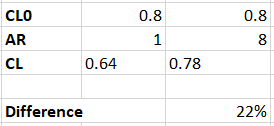
If we take a NACA 2412 airfoil at 5 degree angle of attack this gives a coefficient of lift of ~0.8. An then if we take a AR of 2 and 8, we can see this would generate a difference in lift of 22%, which would hopefully be measurable.
The equation of lift is as follows:
L = C\_L / 2 \* A \* rho \* v^2
Where
- L is lift
- C\_L is the coefficient of lift
- A is the planform area
- rho is the density
- v is the velocity
So for your experiment to be successful you’ll need to ensure
1. You can accurately measure lift
2. You control the other variables such as planform area and velocity
What is your experimental setup out of interest? And how do you plan to measure the lift force?