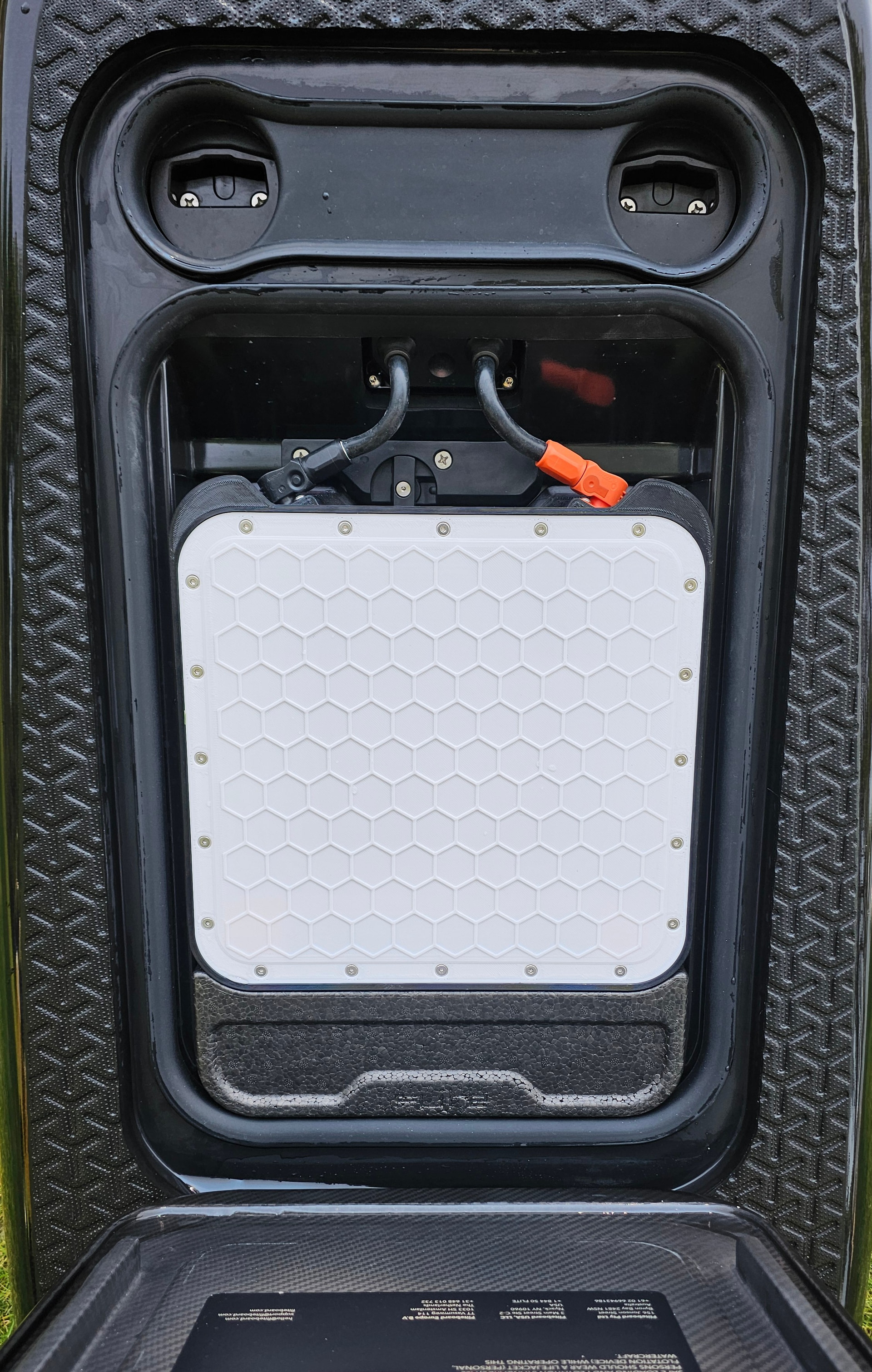
Well, I suppose it is about time I share what I have been working on for a little over a year now… An aftermarket battery!
Right away I want to make one thing clear: this is for DIY guys or extreme Fliteboard enthusiasts, not for someone who rides in gear level 12 a few times a month.
The primary benefits are weight, power, and run time. Depending on configuration, cost can also be better as well.
Starting out, the enclosure is available immediately for the guys who know how to build or source their own internals like the cells, BMS, etc. (more people than I expected, to be perfectly honest).
For the guys who don’t want to go through the whole process but still have a bit of know-how, I offer a kit. For someone who is familiar with lithium power systems, it will take roughly 20 minutes to finish building. The first few batches of kits are spoken for already, but there is a waitlist to join if you are interested. Buyers will be verified before purchase to ensure they have adequate skills and understanding. Like all lithium batteries, these store an extremely large amount of energy and should be treated with care. If you don’t want to wait, there is a blog post detailing what to do and who to contact.
Safety is extremely important and I can not stress enough that if you are not familiar with lithium batteries, do not try building or modifying one yourself.
There is a FAQ section and blog posts on the website, but to answer some of the most popular questions:
The cells - I currently prefer using tabless 21700 cells, specifically the 60XG, RS60, and an unannounced 7Ah class cell. For people where cost is no concern, the 70P is an option that is publicly available, but it suffers from a few issues and I am not a fan of it.
True solid-state batteries are just not there yet for our application, but semi-solid state cells are. More to come on this in the future.
Compatibility - Currently, there are no software restrictions on using an aftermarket battery. There are a few things that won’t be quite as seamless as an OEM battery, but nothing huge (See FAQ and blog). If they bug you, I have something I am calling “The Bridge”. It makes it so that an aftermarket battery functions and interfaces with the Flite system just like an OEM battery. I am currently looking for testers for this before a full release.
I do not expect Flite to try to block aftermarket batteries for a few reasons. Mainly that the people running Flite and working there are genuinely good people who want to see the sport grow and innovation take place. I also don’t expect enough people to use aftermarket batteries for them to care from a monetary perspective.
Currently, the firmware on The Bridge would be detectable by the flitebox and the logs offloaded to the app when syncing sessions. A second firmware version I have can perfectly mimic an OEM flitecell and should make it completely indistinguishable from an OEM one. I do not plan to release this unless needed and again, I don’t expect to. Just want to make people aware so there is no worry that they might go through a bunch of work for nothing.
If there are battery options out there that are so far ahead of what is currently available, why doesn’t Flite use them? - Redesigning and certifying an entirely new commercial battery is an incredibly expensive and time-consuming process. I expect them to need to release a new battery in the very near future as the cell they currently use, the P42a, is very outdated to the point that supply is becoming an issue and cost is going up due to the factories not wanting to make a cell 5 generations old when they can make current gen ones. Many other battery manufacturers have run into this, and likely Flite’s battery manufacturer is no exception.
If you have any questions that are not answered by the blog or faq section, please let me know. I have tried to add the common ones I have gotten so far, but I’m sure there will be more 