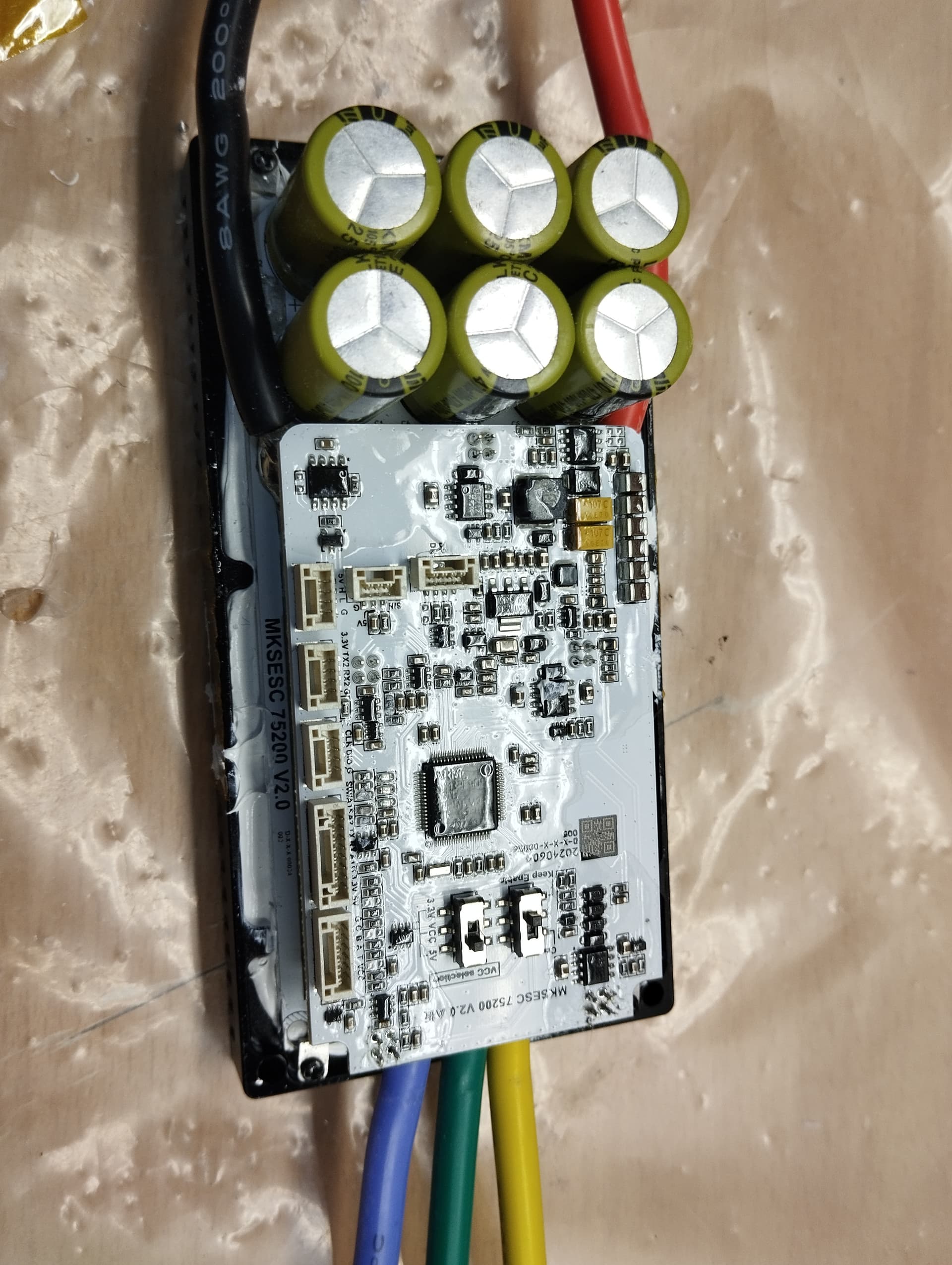
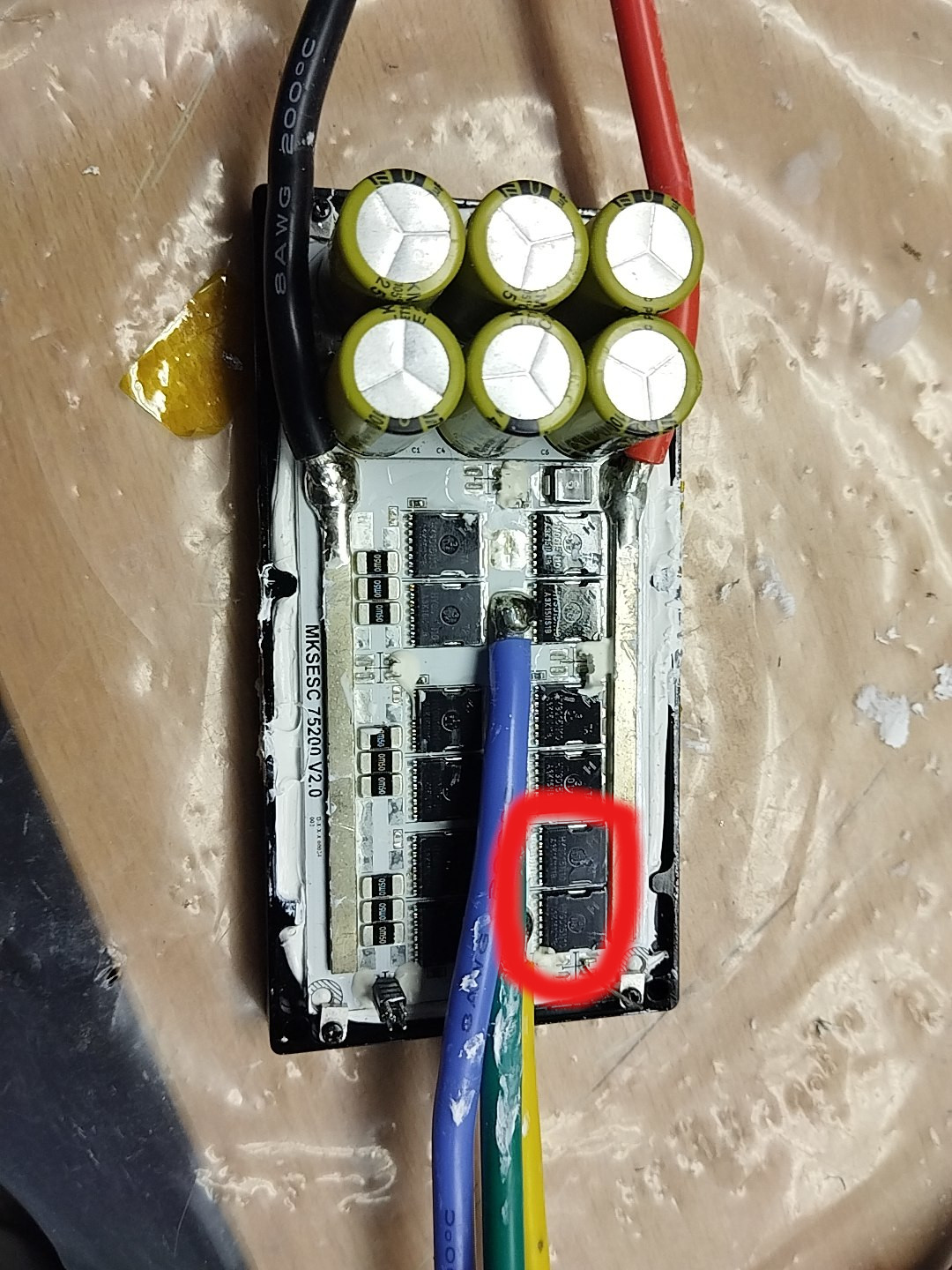
Hi! i had yesterday my first real water test and it did not go as expected, the motor cables ran into the prop and the ESC has now a short circuit in one of the six mosfets (they are actually 12 since it is a 75200)
I wanted to post my experience because I have also had the “that wont happen to me” syndrome and i have learn some things about it:
-The first one and quite clear, fix the cables to the mast properly
-I am quite happy that i have a BMS in my batteries for charge and also discharge, along my build i have seen that sometimes the BMS is only used for charging, i don’t know what would have happened in that case. Do you have experiences?
-I found the the following link very useful to diagnose my ESC before taking it apart: https://solutioncenter.yaskawa.com/search/documents/11185/
On the step 3 I get 0v for the first phase and 0.495v for the other two, in the step 4 i get short circuit on the first phase and open loop in the other two. the rest is fine, also my first phase is toasted.
If you have such system you have to have fuse in the battery.
I have 40A BMS for charging battery and my system can provide 400A peak ( 13S10 with 40A 21700 batteries) - so I have also 120A 60V fuse.
This is even safer them full BMS - as it is more reliable and will just cut the power - BMS in theory could keep giving you high current until thermal shutdown. So generally it is good idea even when you have full BMS ( as last chance protection).
Even if it does, it would burn out almost instantly at 100+ amp.
If you have a VESC, that acts the same as a BMS for discharge. Also uses the same technology (MOSFET’s). I do not see any additional safety there, just more parts that can fail.
A fuse could be “safer”, but I also do not see many real situations, where it would actually do anything.
In the most likely cases for shorts, water ingress or condensation, it would not make a difference imo.
If they break as open-circuit the current would become 0… You might get an inductive voltage spike but still.
It is quite different, the VESC is driving the motor inductance and is at a significant higher risk geting inductive spikes shorting the mosfets. The BMS transistors often would survive this and can therefore shut off still. Most mosfets in these power ranges will survive over kA current for short periods (ms), which could be shut off depending on bms construction.
i meant closed circuit… the MOSFETS in the ESC have failed close circuit
is there any way to protect the ESC from voltage spikes? i mean, that the cable gets cut does not happen so often, but i suppose that if the mr60 connector gets yanked the result would be the same…
I finally managed to repair my ESC, on the meantime I got a second one, so the repaired one is now backup.
The Problem was as diagnosed, one of the MOSFETS was shorted out, so 5 euros in aliexpress did the trick, on the other hand, if somebody is considering trying this repair, you will professional equipment, a pcb heater a hot air gun and a soldering iron with a lot of power. The aluminum pcb are no joke to solder…