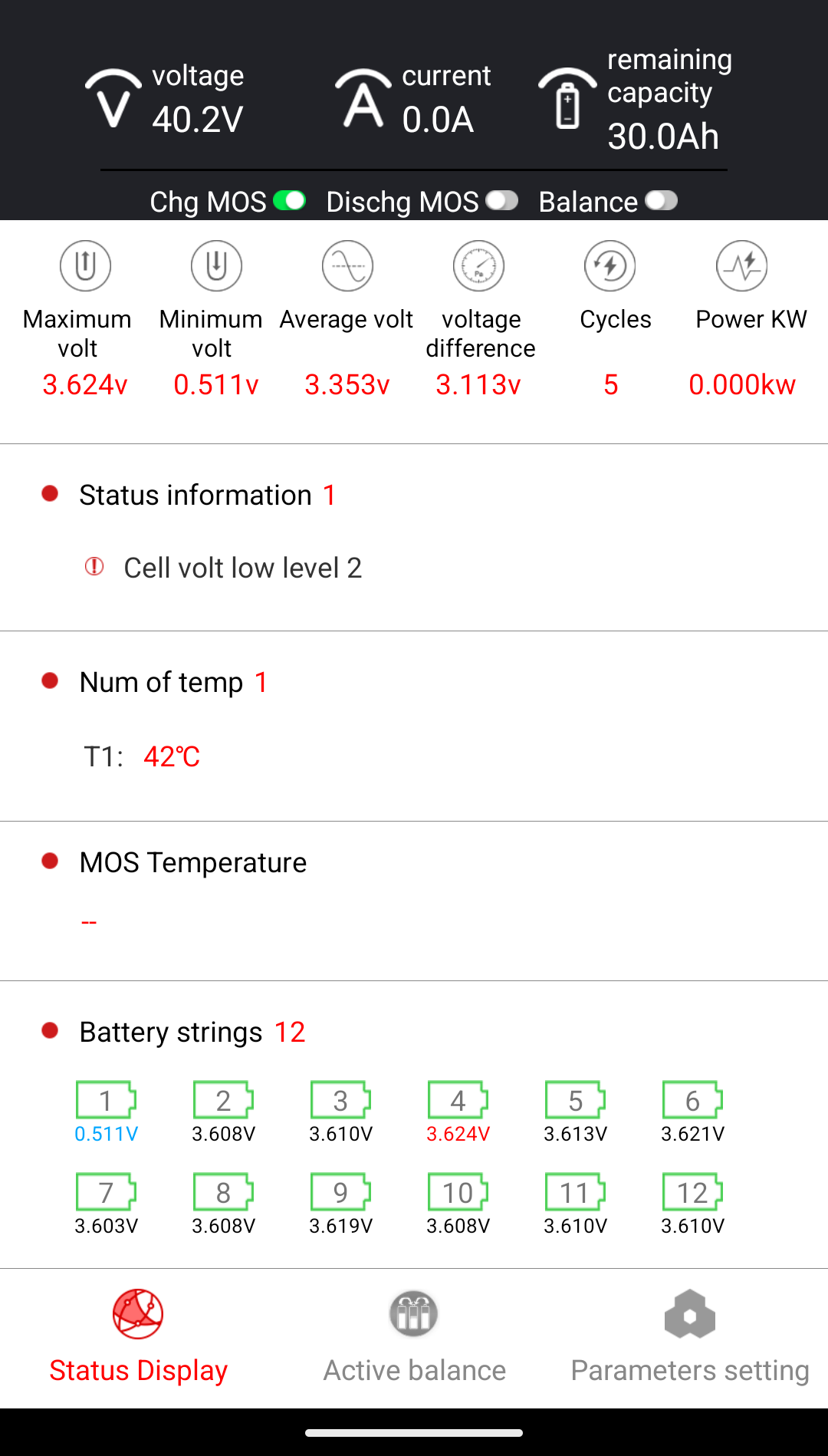
When I plug in to charge it gets really hot because all the current is going to the low cell.
My question is should I try to replace that bad set of cells, or just be happy with the use I’ve had from it, and to play it safe and discard the whole thing? I don’t imagine trying to undo the nickel strip and plug in new cells will be easy, nor safe.
I think I know my answer but keen to hear any opinions.
Did you actually mesures the voltage of the dead cells?
Could be that you have a bad connect from that row causing the BMS to read wrong and put all current in it when charging.
Had a cell die on me with Molicel 42a (which normally test quite reliably) 12s2p pack. Sadly only after a few discharges
Taking it apart to see what can be rescued. Used a removeable potting compound but it’s still a bit tricky. Likely won’t be able to reuse the cells for another assist pack but maybe for something else.
Can’t confirm what causes it yet until I completely separate out the dead cell. But curious what other people have found as causes in similar situations. I suspect a low voltage cutoff of 2.8 might have allowed a cell to see too much stress during voltage sag. What do you all think?
Those cells can technically go to 2.5V under load, so resting probably a bit higher. Seen plenty op reports. Don’t think a couple of cycles under 3V would’ve caused a cell to completely die. Usual way of cycle life testing for these kind of cells is to go from 4.2-2.5V, rest, charge,rest,repeat. They can do this hundreds of times.
Yeah. Me neither. I had my low voltage in Escape32 set to 2.8. But who knows. I’m gonna set it higher just in case. Maybe I was just unlucky with a bad cell. We’ll see if this happen again on my second pack before I build a third.
Could be. Molicel is known for there great quality though. Maybe you pierced the steel can during spotwelding? Please let us know. If that happened, would explain why it worked for only a few cycles.
Nothing to be found upon disassembly unfortunately. Quite the destruction to open it up so no saving any of the components
Unfortunately my second pack has something causing a very very slow leak on one cell now too. Under normal loads it charges and discharges at the same rate as other cells, so nothing seems amiss in that sense. But when left sitting something is causing it to leak current. Very frustrating.
It definitely sounds like you are piercing the cans. It might be hard to see if the nickel is still on top. But a slowly leaking cell, is a good giveaway of a pierced can. Can you smell anything sweet?
Hard to say. Tried to dial in the spot weld to the minimum amount that resulted in a good weld. One that couldn’t easily tear off but left a bond between the two materials when I tested them.
Tried copper-nickel sandwich tabs on the second pack, which required more current than just nickel, but tried to dial it in the same way.
I’m suspected a dead mosfet on the bms but I disconnected it so it wasn’t that So I think I must have a crack or something in the cell can
Weird. Try to find a crack!
Next time, use pure stainless steel 304 instead of nickel. The nickel or stainless steel is only required to create heat for the copper to weld as it is so conductive.
Since stainless steel is a much worse conductor than nickel, it will weld much easier. Meaning, you’ll require much less power to achieve the same results.
For my last build I used stainless steel 0.1mm on top of 0.1mm copper. Had awesome welds with roughly 60J on 1150A with a Kweld. Battery works perfect.
To rule out the BMS you can disconnect the balance lead and see if you still see discharge.
I have seen on a cell that was welded with too much energy the cell was damaged internally even with out piercing the can resulting in a slow discharge of the whole P row over several days.
Love this. Nickel I the width I need for these custom cut tabs is just too expensive here. I’d imagine ss will be a much cheaper solution too. The sandwich path has been a super informative one on my last two packs.
Indeed. Yeah, I tested the bms by removing things above and it turns out it was that. Might have been welds with too much current though. I’m able to get away with less than I thought after another round of tests with the sandwich method.