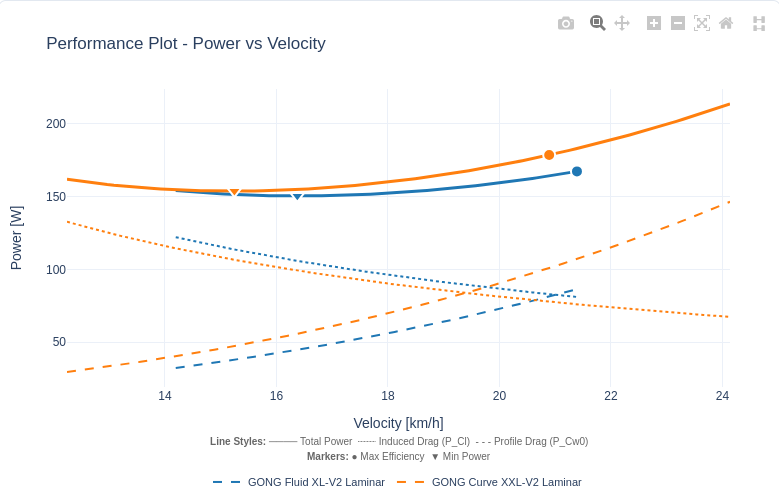
Hi there, i have been working in a intuitive way to calculate the power draw of foils for almost a year and with help from a friend we finally got it to the point in which i think it is worth to share, give it a thy and let me know what you think.
The calculator is intended to be used for pump foil, as a few watts make a world of difference, but i believe for e-foil might be useful as well. I have many models of gong v2 as that is the setup i use, if you want more wings, let me know! in that case i will need the surface area, the aspect ratio, the thickness and the maximum chord.
here is an example how can it be used, by comparing a Gong fluid XL with a Curve XXL, similar area, similar AR different profile thickness:
Hi, can you elaborate on how you get the induced drag and profile drag from only the parameters surface area, aspect ratio, thickness and maximum chord? I am very sure that I can build a wing with the exact same input parameters as your best wing, but an awful performance and power requirement… E.g. by taking a rectangle as airfoil.
For the induced drag i use the induced drag equation, the oswald factor is also defined for each wing and taken into account depending on the area distribution along the wingspan and how elliptical the wing is.
For the profile drag I have a database of the naca 63-6XX with thickness between 6 and 17% and Re*sqrt(CL) between 2.7 and 5.4e5, so I can interpolate for a given (Re,CL) the profile drag.
As soon as I have my foil assist ready I want to do a validation of the calculator with the log data, but that will have to wait until summer…
sure you can, the calculator is assuming commercial wings so I expect the wings to perform at least as good as a naca profile out-of-the-box
There is limitations to the results that you can obtain with public available data, and the available data seems to indicate that both those wings are very close to each other in terms of performance. That does not mean that both wings feel the same, I believe that the PnG v2 uses the same airfoil as the fireball range, and those have higher camber. Such a comparison is besides the goal of this tool, it is better suited for comparing different wing planforms, for example, if you got a PnG v2 wing and you are wondering which fireball wing you are going to get next.
The results that the calculator gives seem to be also backed up by the review from Yvonvite, as he does not recommend getting a PnG v2 if you already have v1
I cannot speak for most the foils, but for the few I know of, your numbers are simply off.
For example I got the data from the Axis 1201 to use it in an own design a while back. I am pretty sure it uses a 11.5% profile. With 135mm span, that gets you 15.5mm thickness compared to your 18.5mm.
That is really a significant difference.
Just my opinion of course, but if you lack public available data, you should not simply make up your own data and also should not present your calculations based on that “made up” data, as physical facts.
That makes a difference of 4 Watts (147W vs 143W for 100Kg and 20°C Freshwater), the difference between PnG v1 and PnG v2 is 2 Watts (133W vs 135W for 100Kg and 20°C Freshwater)
Regarding AXIS foils and how do I get the profile thickness, Axis shows the Volume of the wings, since I also have the foil surface, I can get an estimate of the profile thickness. I am aware that there is a level of uncertainty with this tool and the reason why I show the values is for people to be able to challenge my results.
If you have a better methodology let me know
The most important part of such a methodology is that it is consistent and I am able to implement it universally, not just for one foil manufacturer