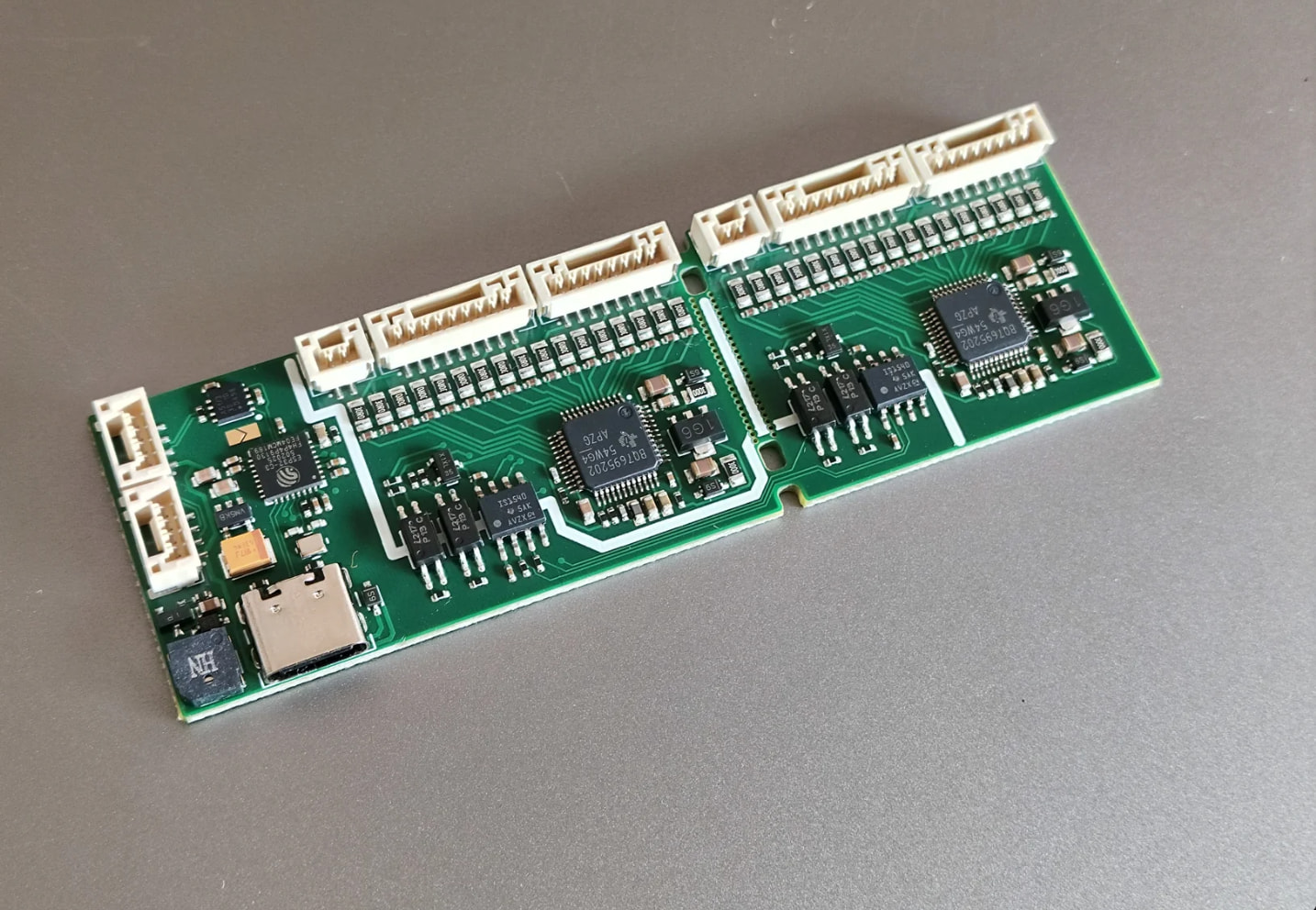
I’m behind JetFleet, based in Slovenia, and wanted to introduce our JFBMS Master + Slave system.
The system separates cell monitoring from charge control:
Slave boards measure individual cell voltages and 2 temperatures per slave. Each Slave supports up to 32 cells, and multiple Slaves can be connected.
The Master controls charging and balancing, and communicates with your VESC over CAN so you can view battery data in VESC Tool.
The basic connection is:
Battery cells → Slave board(s) → Master → VESC over CAN
For a battery split into several modules, the separate monitoring boards may give you more flexibility when arranging the electronics.
This is a charge-only BMS: motor discharge current does not pass through it. While riding, the VESC must be configured to use the BMS data for cell-voltage and temperature limits.
There is also an alternative called JF Link. On a compatible controller, the Slaves connect directly to the controller’s CAN bus, providing cell monitoring and balancing without a separate Master. JF Link does not control charging or switch the charger off.
I’ve put together manuals covering wiring, configuration in VESC Tool and firmware updates:
The firmware is still under active development. I’d be interested to hear what you need from a BMS for your DIY eFoil builds. Happy to answer questions about wiring, battery configurations or VESC integration.
You’re correct, all cells within the same parallel group share the same voltage. That was just poor wording on my part. The Slave measures individual series-group voltages, not the voltage of each cell in a parallel group.
As I’m also in some onewheel discord groups I know your BMS from there. I even have a jetfleet F6 vesc. The difference to onewheels is battery size, most builds use 12 to 16S, some 18S, but more than 2 cells in parallel. So the max balancing current of your BMS could be a limiting factor. Many builds use batteries without BMS and balance charge with RC chargers, other use some bigger BMS’s
Where I do see a use case is for Foil Assist systems which usually use 8 to 12S, 2-3P 21700 LiIon cells. I was considering to use an Ennoid for my assist which is similar to your BMS, the only reason that stoped me was the price, I could get an ichargerx12 for the same price. It suppoerts up to 2A balancing current and I can use it for several betteries.
For people who do not want to bother with balancing connectors and RC chargers, your BMS could be an option, especially if the cast the battery with compount. With a BMS only 2 leads are needed, no balancing wires.
I think it also depends on the price, 12S module would probably suit most for assist.
Thanks for the feedback, and nice to hear you have an F6!
Our BMS has around 40 mA balancing current per channel, but it can balance up to half of the cells simultaneously. Many 2 A balancers only balance one cell at a time, so the difference in total balancing time is not as large as the current rating alone might suggest, although 2 A is obviously still faster for larger imbalances.
We also took a slightly different approach to balancing. In our firmware, balancing only starts once charging is complete. During charging, the charging current is often noisy, which also affects the measured cell voltages. This can cause the BMS to start balancing one cell and then another, even though neither actually needs balancing. Once charging stops, there is no charging current flowing through the cells, so voltage readings are much more stable. This allows us to balance cells accurately down to a few mV difference. The BMS can continue balancing overnight, so high balancing current isn’t really necessary if the pack is already reasonably balanced.
Regarding smaller packs, the 32S Slave is actually built from two 16S sections, so for applications requiring 16S or less, the second half can be removed.
I think you’re forgetting that cells generally don’t need much balancing to stay closely matched. I’ve used a battery pack for over a year, and the cells only drifted about 40 mV apart in that time.
You can still use the battery immediately after charging without balancing it every time. Occasional balancing is usually more than enough to keep a healthy, well-matched pack balanced. There’s really no need to force the entire balancing process into every charging session.