Elevate, like MikeL I appreciate your approach too. Especially for the first time in hydrofoil history, eFoils provide an objective environment with figures (volts, amps, speed) and I’m sure that kitefoils and windfoils development in return will beneficiate from that too.
Yes, speed and weight range do matter. I mentioned Banga and its Chubanga heir because a lot of CFD has been carried out, extensively tested before and during competitions and their high AR front wing is surprisingly easy flying and very tolerant according to the people who have tested them.
As you mentioned “profile efficiency” my answer was targeted at that point.
Moses 683: not obviously optimised for least drag as it is a freeride front wing. It would be interesting to test your new wing back to back with the 639 (windsurf competition with high aspect ratio) more optimised to that aspect which doesn’t necessarily mean unpleasant flying handling.
As a conclusion, if you have the same footprint as the 683 with same profile thickness but use a more efficient airfoil section and get the same speed with 20% less power, congratulations. 
I would appreciate your 639 figure comparison if available.
By the way, do you have an availability date for your line of products ?
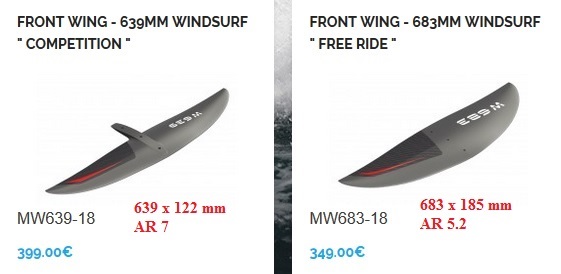
As per:
I have to politely disagree. Seems to me that the kinematic viscosity in the Re formula was not switched from air (10-5) to water (10-6)
200.000 is 5 to 8 times too small. According to the values you gave us (40 kmph that is 11m/s), water temp = 10°c
Moses 639, Windfoil competion low drag high AR, Re = 1.600.000 max at wing root
Moses 683, Freeride fun, low AR, Re = 1.100.000 max at wing root
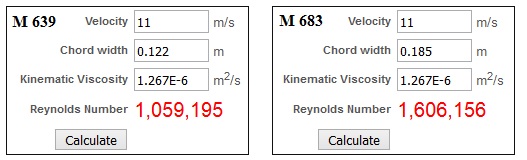
One thing to notice is that if one decides to use the same wings on a kitefoil with a wingspan shorter by 40% (40cm typical value), the Re doesn’t change because only the chord length is considered in the Re formula.