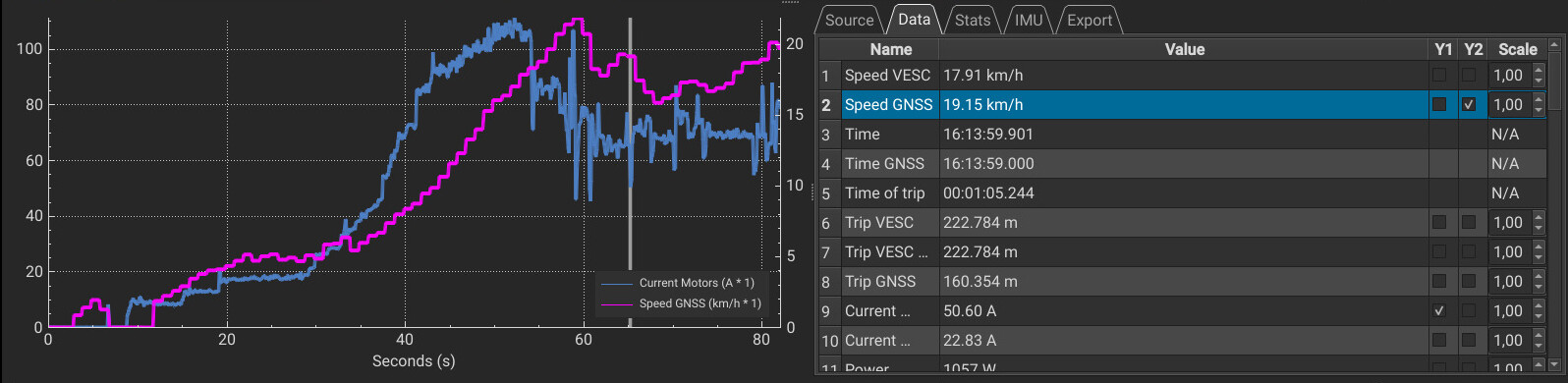
Looking at some output of your foilcal app my own it underestimates the power by a lot.
In my case using a gong curve v2 L and my 90kg I can foil@25kmh at 1000w. Thats using the flight prop which is know to be near if not the most efficient prop available. I have also the curve xl and xxl and the power is only marginally lower but thats also lower speeds The L is much more fun for me and I think I will get an M size coming up.
Those small wings are sadly not yet built in as I started working on the foil calculator when i was doing dockstarts and efoil was not yet a project. But when a soon as i can i want to add them.
Keep in mind while reviewing the results that the values are only the front wing, in order to calculate the overall power I assume the foil drag to be twice as the front wing alone. I have not found any Source which provides a better way to calculate this value.
a somehow close wing to your curve L is the Xover XL v3 ( slightly more surface, very close AR and thicker profile) for that wing and 90Kg at 10°C of water i get at 23.7 Km/h 213W if the wing is polished (Laminar) and 314W if the wing is completely scratched (usually a real wing is somewhere in between)
For that case the whole foil should be somewhere between 426W and 628W, if your foil is pulling 1000W, when considering the efficiency of the prop, I think they are somewhere where i would the results to be expected.
I am looking forward to measure with my efoil totally different wings (like for example a x over XXL and sirus XXL) and to provide better references than to say from the predicted 213W you are actually pulling 1000W but that will take time…
I dont think I saved any vesc files but possibly some others have. Another quite big source of drag is wind resistance of your body. Very noticeable on a breezy day when you change from an upwind to downwind course.
You calculations are probably really good but the total power seems not to be dominated by the wing. Its not even 50% typically. My friend rides an xover v2 L and his result is almost the same as mine on a given day.
No matter how good the wings are I think you will find 1000w at 25kmh is about as good as it gets unless you reduce total weight.
Propeller efficiency is really an interesting area. I have printed and tested a ton of props last summer. Now I have a design as good as the flite prop after a lot of iterations. For ease of printing and finishing a 2 blade prop works well.
Just to give some examples:
With a Curve M V2 setup I do roughly 1000-1200W to stay on foil with a Flite prop and 65161 motor.
With a Curve L with a FR 3 blade and 70175 I do roughly the same.
If you can get below 60wh/km you are very efficient.
This season I’ll test my new Veloce H V2 setup.
Can confirm, my setup is very efficient with a north sonar ha 950 / 750 and a small stab, 14S, FR Motor and a Flite prop. Best I got was 53.3Wh/km @25km/h average speed, 95min, 2 starts.
In my experience, the size and efficiency of the foil comes into play if you run faster, like 30km/h average or more. I still get 60Wh/km @30km/h average. If I run 45km/h consumption goes up to 110Wh/km.
yeah that’s a good point at 20-30 Km/h you can not ignore wind resistance anymore
I have been playing around with XROTOR, and i designed a prop which was supposed to be 60% efficient, althogh my flow conditions were totally wrong, i thought i would be flying at 15 km/h with a sirus XXL and a power draw around 600W. I still have to water test it, i will post my results…
i will definitely do
I am starting to get quite curious about this flite prop… is this the one you are all talking about? prop
thank you all for your input!
Btw, i did yesterday my third test, whit the default VESC settings for cutoff and went amazing. the power draw gets also lower after the acceleration. the feeling was amazing and after 3 batteries i was already doing a few turns. to the date my record for pump foil is 22 seconds… I am looking forward to improve my pumping technique!
Every printed propeller I have tried (including a 3d scanned fliteprop design, volkers, etc) has been a bust. How do you get them to work? I have tried sanding butter smooth (after printing with full walls), painting with epoxy and sanding again, just the raw print file… none of them seem to give me the speed I need.
So far I have only tested fixed blades and find with 65161 that pitch 7 is the sweet spot for my setup. I suspect the most folding designs will be worse than the flite prop for efoiling anyway.
I used aluminium printing service in China. I had to sand a lot to get them shiny. Ich tried round leading edges and sharp leading edges. For surface piercing application (assist) the sharp edge was better.
Most critical is the surface quality I think
If you have the motor near the board, it takes skill to avoid that.
If it ventilates you lose power, drop lower, it reengages you rise, it ventilates, you drop, like a rocking horse.
I am starting to get some Kms in my setup, at the time I have 6 batteries down. although I am heavy (95Kg) and my board is also quite big and heavy.
My power consumption is at the moment 120wh/km at 25 km/h I hope it will improve with technique, currently is my goal to stay on foil as much as possible, but I am definitely not an efficient foiler…
So far it has worked amazingly (cutoff start 3.4v, end 3.1v per cell), the batteries are 3.4v at the end of the session and the minimum voltage under load was 3.2v per cell, but with the default settings and batteries starting at 4.1v per cell i get 6Ah (260Wh) out of my battery (12s2p Reliance rs50 10Ah 432Wh) is this normal? i am pulling between 2000 and 2500W (83 to 104 W per cell). Battery mooch says the RS50s have 15.5wh at 90W per cell, which would make my battery effectively 372 Wh