Look Jezza I wish to build a board that can handle rough conditions Therefore I am going to build a board which has V bottom, Pin tail and ponited nose with a large nose rocker. What I am trying to achieve is to stop the board nose diving into waves, stopping completely and absorb more impact your science (2) agrees but the slow recovery is incorrect with a large nose rocker/ bow which is more likely to keep the board nose above water while applying weight to your back foot therefore staying on the board and not completely loosing your speed cause of nose diving/ completely submerging the board. The majority of offshore boats follow this logic. I get it has some cons like requiring more power to get out of the water and as for the con of less steering are we not supposed to be riding the hydrofoil as much as possible rather than the board. I have built multiple boats with flat hull and V hull boats and from my experience the V hull is better for rough weather hence my route sorry for not being a sheep with my board shape🫡
Go wild then
Considering guys have ridden existing efoils in pretty much every condition possible, including Nazare, I think they’ve more than proved they can handle anything the Algarve can throw at them…
Nazare is the biggest waves (Swell) in the world and not something I will be trying anytime soon or ever. In my experience its normally the chop that catches you out not the more predictable swell so I going to try chop the chop lol
Right since you and @Kian are thinking same on mast will dial it back to the 85cm 19mm thickness can always upgrade later on to the 92cm as its only 100€. I was also thinking about dialing the the voltage back will look more into the 16s, charger and bms. My reasoning for the killcord is to limit the board getting to far away when on cruise and I don’t want to use a prop guard so essentially to aviod injury from that nice prop
Flite prop should have plenty of thrust, even for heavier roders.
So looking more at batterys I am thinking a double pack of 16s7p samsumg 21700 50s where i can use 1 pack giving 2kwh or 2 giving 4kwh.
Each pack will be ruffly 9kg is this gonna be to much with a large front wing?
The Vesc will require a battery amp limit of 150a-175a and a phase amp limit of 200a. Any better options?
Since I plan a pin tail board would it make sense to place one battery pack in front of the mast and the other behind for better balance and removing the rear pack for shorter excursions?
Any recommendations for anti spark switch?
I plan to start with building batterys first then purchase the rest of the parts so I can size everything correctly when making the board.
Why do you want an anti spark switch?
Just use a QS8-S
Correct me if i am wrong but I thought the anti spark switch was for voltage indifference between the battery packs
Keep them roughly at the same voltage, then there is no spark when connecting them in parallel. Antispark connectors like QS8 are needed to avoid a spark when connecting the vesc, as the large capacitors cause a spark when connecting without an AS connector.
Why will it require that?
Phase amp 200, yes, when starting with low RPM and high torque
But battery current is dependent on the max power you will use, which probably will be 3 or 4kW if you dont want to break any speed records? 4kW on a 16s battery is approx 80A
Anti spark switch cannot do that, neither can QS8
Either you need to bring the packs to the same voltage yourself before connecting, or have a specialized “battery equalizer”
Or just only connect one pack at a time, and switch half way, since you plan to stay close to shore. This would also add a way of reduncancy if one battery fails, you can still get home on the 2nd
Thinking about that, it may even be smart to add a 2nd VESC, in case the first fails, if you plan on long trips. Doesn’t add much weight or cost…
BTW if you need another reference for distance/energy/efficiency, I usually foil at 50Wh/km at 20-22km/h (1kW)
That would be 12mph, 80.47 Wh/mi
So for the 50mi goal I would need 4kWh battery (I run a 1900Wh in my board and once did a 36km / 22mi trip) with some battery to spare at the end, but definitely no leg muscles left 
70kg bodyweight, 18kg board incl. battery
Its just something I saw hunting for info cheers for the heads up and all the info.
A Back up Vesc sounds like a smart idea would that be switch over or one operating with each battery pack?
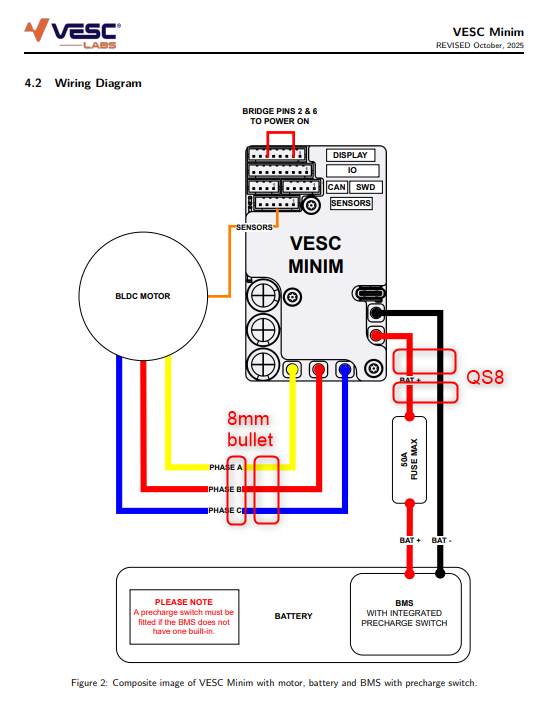
I have been hunting for a good wiring diagram so I can understand a complete system better but I haven’t come across one yet.
I watched your first battery video and subbed keep up the great technical content we need more of it.
Thanks again
Ludwig
The design depends if you can go to shore to switch batteries or if you want to do it on the water with the foil floating there
On shore is easier, since no wave can splash into an open board
Off shore you would need some waterproof switches or something you can operate remotely, maybe overkill for the 1st prototype you build…
So with onshore battery swapping I would build the following:
2x Battery pack with QS8 or similar antispark conenctrors each
2x VESC with matching connector on the input and 3x bullet type connectors on the output (I like the 8mm gold bullet connectors)
1x Motor with matching 8mm connectors
Onshore you can just unplug empty battery and connect full one with the QS8 connector
If a VESC fails you just connect the motor to that one with the 8mm connectors and the battery with the QS8
Schematic for that will be rather simple…
[Bat] → QS8 → [VESC] → 8mm Bullet → Motor
VESC labs and TRAMPA have nice manuals for their VESCs you can get inspiration from
The image below recommends a BMS in the battery, that is debatable for your application… I would leave it out and monitor the battery during charging only, or if a BMS is added it should only give out a warning with sound/light/vibration and not kill the power to the VESC
Bingo Mr liquid knowledge 
I am going to start with building batterys which I have never done. Then buy rest of the parts and finally build the board so everything is sized correctly.
What battery spot welder, BMS, charger would you buy?
The plan is so far 2x 16s7p samsung 21700 50s.
I should require 224 cells how many spares should I purchase and is there anything else you recommend doing or buying for the batterys
I really like the kWELD
Pricey but reliable and supports European products
I don’t have a perfect answer for that. I have both “dumb” BMS for 20-30 Euro each, 40A so for charging only, as well as a JKBMS “smart” with bluetooth… the cheap ones will do fine for shutting off in over- and under-voltage and temperature, the smart one will let you check balance in the app, which is nice too. Wouldn’t trust any of them with my life, so charging and storage will be done outside the house.
Built myself from a server PSU and CC/CV step up. However CC/CV chargers are easy to obtain ready made as well, as accessories for all kind of e-scooter, bike,…
I usually have 1 or 2 cells to check the welding, if the welding energy is nicely setup you should not damage any during the process. That said I usually order 10-20 more since they come in handy afterwards for other projects too and ordering more should something go wrong sucks.
You will need nickel strips, battery holders, fish paper is handy, and a properly waterproof case for it. For assembly and maintenance a good voltmeter, soldering iron, basic tools.
Samsung 21700-50S 5000mAh - 35A 3.31€ per cell need 238 VS Molicel 21700-P45B 4500mAh - 45A 4.25€ per cell need 270. Are the molicel worth an extra 360€?
Guten Morgen Ludwig
Would this battery spot welder do the job? Nickel or Nickel steel for the strips? Molicel vs Samsung? 360€ more for Molicel and 16 more cells for same capacity but they are in stock samasung out of stock.
I have no idea There are many (cheap?) spotwelders on the market, the only one I trust is kWELD. You will save many thousands of euros building this eFoil youself vs buying it… why cheap out on a fundamental tool?
If you have seen my calculator, you can check the difference for your application and judge. Feel free to share your results from the calculator if you want to discuss together
The only cells I have experience is Murata/Sony (VTC-x). So far no masurable cell drift in my packs. Other people I know with Samsung cells need 1A balancers to even keep them in balance. May have improved with the new cells…
Totally agree with the good quality tools. My issue with the kweld is I must assemble it meaning I could make a mistake and cost myself more money. Will checkout your calculator👍
Assembly is a big word, for someone who wants to build a whole eFoil
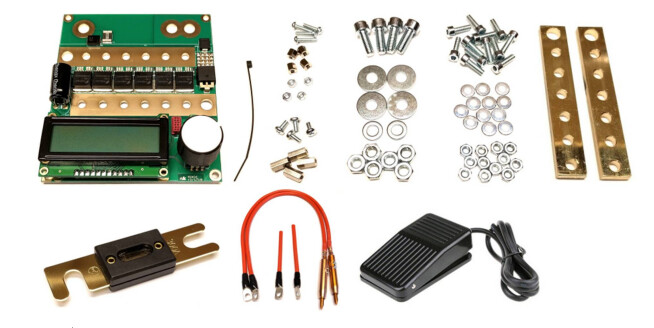
kWELD has a kit that looks like this: You literally only need to tighten screws and plug in 1 connecor 
Lol 
 Roger that ordered.