Glass-In Foil Assist

Then I mentioned that the company might be willing to work with you. What I meant is this: if you have access to batteries in high‑value destinations, that instantly gives any equipment vendor a competitive edge. Reliable battery availability is a major bottleneck, and solving it changes the entire equation.

But then I started thinking about something else entirely. When we travel in an electric car, we often choose rentals that offer a charger. That means businesses like hotels, resorts, and similar venues could also become part of the ecosystem. They might even be willing to subsidize you, because supporting battery availability directly benefits their customers and increases their own appeal.

Foil drive got their patent through even though there was prior art online. Now its up to another company to challenge it which is expensive and many companies shy away from unless they are large.
A glass in assist with foil tracks was novel 3 years back. weirdly enough its so simple to do in many ways.

My issue was never designs or prototypes. It was how to scale into production and how to find time as my kids were 0 and 3 at the time.

Yes, you are right. This board (Foil.zone) is listed as a prior art. Below is info from Gemini .
Looks like no patent yet (application)and may be never.

Foil Drive Pty Ltd actively protects its retrofittable electric hydrofoil assist technology through international intellectual property filings.

Key IP Filings & Status

  • Primary Patent Application: International PCT application PCT/AU2023/050128, filed in February 2023 following the development of their Gen2/Assist MAX system.
  • Priority Claim: Claims priority back to February 25, 2022.

Core Invention & Technology Scope The patent portfolio focuses on a lightweight, modular electric drive unit designed to convert existing standard hydrofoils into electric-assisted foils. Key innovations claimed include:

  • Removable Pod/Mast Drive Assembly: Mounting an electric motor directly onto an existing hydrofoil mast using a custom clamped pod, allowing the motor to be positioned along the mast.
  • Electronics & Battery Housing: Integrated battery and ESC enclosures that mount directly on top of or under standard surfboard/foil decks.
  • Integrated Mast Components (Gen2/Fusion): Integrated motor-cable tracks and streamlined mast setups designed for quick attachment and low drag.

Industry Context & Prior Art The patent space around electric hydrofoils is heavily contested:

  • Prior Art Challenges: Open-source DIY efoil communities (such as Foil.zone ) and early commercial concepts (e.g., Slingshot’s US10279873B2 “Assisted foil for watercraft” filed in 2017) explored similar under-board or mast-mounted motor concepts prior to 2022.
  • Commercial Impact: Foil Drive’s IP strategy aims to lock down the retrofittable “foil assist” category to prevent direct commercial clones of their mounting mechanisms and modular drive design.

How about this one? was it issued? Slingshot’s US10279873B2 “Assisted foil for watercraft” filed in 2017

Yes, US10279873B2 was granted.

Key Details & Status

  • Filing Date: November 7, 2017
  • Issue Date: May 7, 2019
  • Current Status: Active (Assignee: Slingshot Sports, LLC; Inventor: Tony Logosz)
  • Expiration Date: Estimated around November 28, 2037

What the Patent Covers Unlike Foil Drive’s setup (which mounts the motor to the mast or underwater gear), Slingshot’s patent specifically covers a hull-integrated auxiliary propulsion system .

  • Mechanism: A motor/propulsion system built directly into the bottom of the board/hull.
  • Functionality: Provides thrust while the board is sitting in the water in “displacement mode” to help the rider catch a wave or get up to speed.
  • Auto-Deactivation: Once the foil generates enough lift and the hull rises completely clear of the water into “foiling mode,” the motor disengages or turns off.

Me too. I spent lots of $ and way more time.
Finally have a working setup- 2+ yrs later

1 Like

I have also been looking at the Rift system pretty closely, and it looks to be a fairly good solution. Keeping the batteries and esc under the board in an aluminum housing will allow for good heat management, and keeping it between the riders feet should mean less disturbance to board feel. I will be interested to see the price point.

Don’t give up, remember there is no such thing as failing, Its just learning. and as the saying goes “third times a charm”. Maybe try to articulate the idea first and file a patent before you get a full working prototype. Then try pitch it to Fliteboard like, Chris Reynolds did with AMPJet.

1 Like

The thing is that Riift has just opened the market wiiiiide. Any manufacturer can technically make electronics to fit in their opening. I’ll bet FD buy some tracks and start making units that fit and then their fanboys use them.

FD just launched their max+ which moves them to 12s and the nosecone is now built onto the battery.

I have been in manufacturing for my entire career and havent come across products so absurdly priced as Foil Drive and now Riift.

I understand it costs capital to start a company and the battery testing certification process is quite expensive, but these are sunk costs that most companies dont expect to recover for many years after a prodict launch.

I work for a company that manufacturers and tests sensors for Formula 1 and almost every other FIA racing series.

We design, temperature test, characterize, validate our own custom PCB’s, on custom made calibration hardware that cost over $30k each, we have 6 cal stations. Our PCB’s are potted to also withstand harsh environments like water and vibration.

Our other caibration machines cost around $1 million each, we have 4, that take a year to build. (I have assembled, wired, and commissioned 3 of them).

Our sensor housings are multi-piece fully machined complex high tolerance parts. Our fully assembled sensors also get temp tested, chacterized, validated again on our expensive custom built cal hardware. We have spent 10 years developing compensation algorithms for our systems.

There are 12 technicians and 20 engineers making good wages at our company.

We also have engineers that travel around the world for track support which is very expensive.

Guess how much 1 of our sensors cost?

Similar pricing to FD Fusion and now Riift.

Our economy of scale is similar, we only sell around 1100 units per year.

These companies are ripping people off from my perspective. If more of their customers knew about how much their products actually cost to make they probably wouldnt buy them.

1 Like

Agreed…look at what a Saite 6374 costs from the manufacturer vs what FD sell a replacement for. The ridiculous price for these alone cheeses me off. At any rate, alot of people have no build skills or aptitude for this type of thing and learning it all really is more like a labour of love. You fail alot but when you get it right its golden.
Homestly though, ive spent more time engineering and building these things but thats half of it for me. Most just want to ride and i get why they spend the money…if you have the wedge it go for it i guess.

Me…ive enjoyed the whole learning process and building them for a more realisitc prices i guess. I do smile wryly when i see “new” FD “inventions” and i think they should credit the original designers for these things…its the fact that FD turn up in a yet another new video promoting “prior art” with that shit eating grin. That…that bugs me alot.
My 2 xents
K

1 Like

Still, back pack assist you can use with any board. Meaning you can have several boards, can try someone else board, can use these kite/pump/prone boards, used boards.
It will always be more accessible and versatile, isn’t it?

1 Like

Your argument is completely valid. But then I guess it also comes down to what the market dictates. FD have been successful at selling at those prices, so why would anyone entering the market not try achieve similar.

I remember when I used to get cost price wetsuits from a brand for surfing. The wetsuit was 4x more expensive off the shelf compared to what I paid. Then I had a relative in the clothing industry and she said its simple, any item from a large retailer is between 4x to 10x more expensive than what the company paid for it.

Anyway, I have some designs and ideas up my sleeve and if I can simplify manufacturing, then just maybe I can seriously challenge the bigger players.

1 Like

While I agree with you mostly - the market largely dictates what you can ask for and also the higher price also indicates a premium product which is what they pitch themselves as. They will have done their homework (I read an interesting article years ago around pricing of jetskis… the demograph would happily spend $18kUSD so companies targeted this) and their investors also want a return on their investment sooner than later.

That said, something I would love to see - as a pinned topic on this forum - maybe the top 3 designs with a simple breakdown step by step - with no discussion… just the facts. As someone who has spent the last year trawling through all the build conversations there is so much gold in the conversations… that the specifics are lost or hard to find (this is where the AIs are making it easier to research foil.zone).

I believe this would make it more accessible for people new to this (like a “start here”). In fact I would wager there’s an opportunity for someone to make kitsets.

A few videos looking at the Riift system have made it onto YouTube. Also their website has details now.
Can anyone identify the motor? Looks like a 5085? Their website states 49mm diameter. Power System – RIIFT

Based on what I’ve read on foil.zone that motor has just enough power for some users, but not really general solution for all. Maybe they’ve been able to squeeze more out of it? Maybe their prop is matched well to the motor?

2 Likes

Interesting.
They seem to have a good amount of money behind the idea.

3.5 kg for the 12s2p battery seems quite a bit too much weight.
Also not a fan of ESC/Motor in one unit.

Compared to an in board solution like I use now, it would just be more weight, for really no upside that I can see.

If you find a shaper to install that track to a board, you could probably get him to do add a hatch to the board instead and you would have a way more flexible solution with less weight.

Pretty sure the esc is in their battery box, which I think makes more sense.
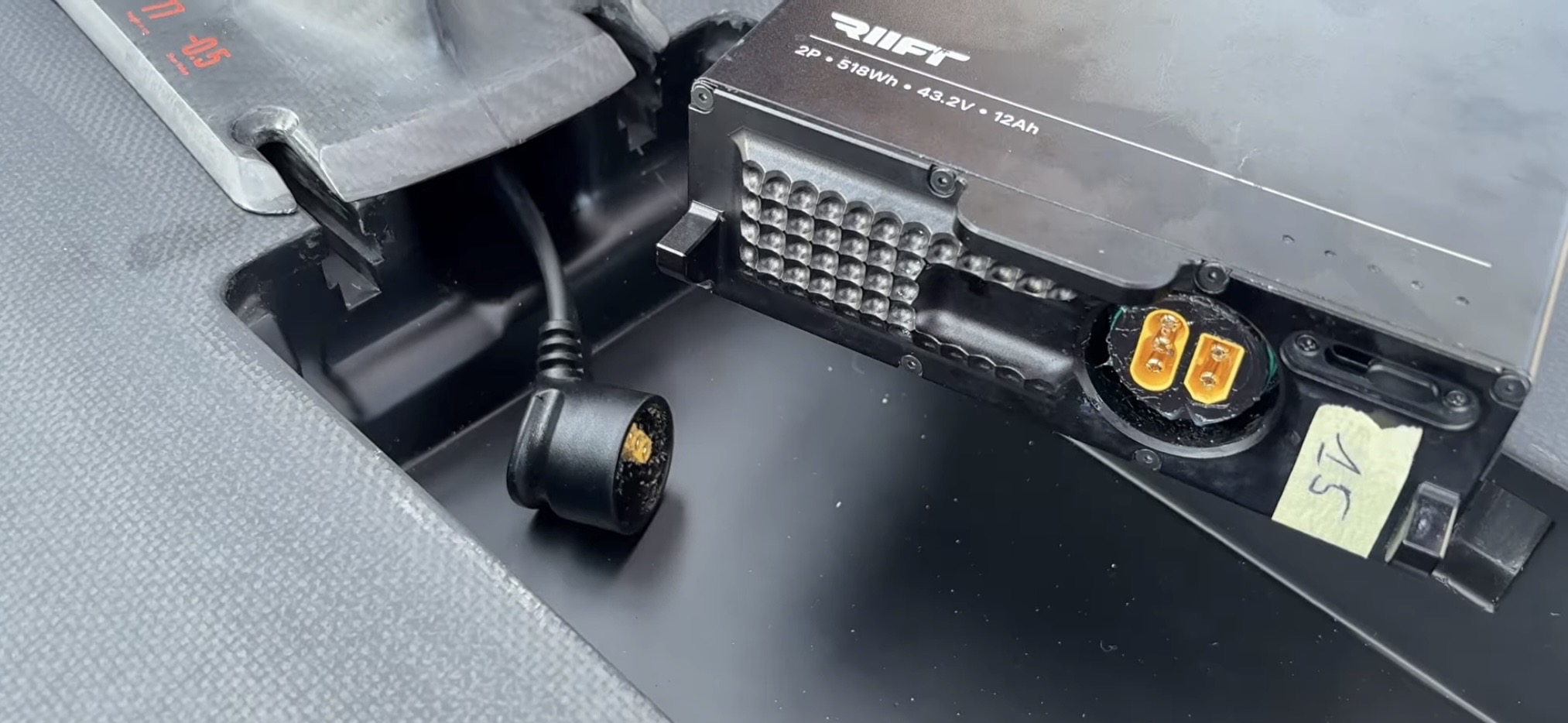
Here is a screenshot on grabbed showing the box. A 3 pin MR60 on the box and motor cable for phase wires, then a two pin charging port.

Ok, that seems even more weird.

So if you want multiple batteries, you also get an ESC and receiver for each?

Guess I will stop speculating.
System looks well designed. Not really sold on the concept yet.

Yes, their theory is that its easier for the user.
But its going to put them in a tricky position:

If they seel the remote, power unit and motor for ±$4k, how are they only going to sell the battery for $1k. That means you are paying 3K for a remote and motor which realistically are $150 together.

I suspect once they have made initial sales, they are either going to radically change their pricing or otherwise be uncompetitive.

What they may do is use an ultrafast charger. So accept a marginal degradation of the battery over time, but eliminate multiple battery purchases…

They kinda advertise how easy and quick it is to change batteries.

But it’s going to be silly expensive anyway.
So putting a EUR 50 ESC and a EUR 10 receiver in is probably a non issue.

The tracks are ±400 USD
The cheapest power system complete: ±5300 USD

Now the biggest issue is how they are gonna offset the spare batteries…