The eFoil of Theseus — September 2026 update
Very long-overdue update to this thread. Two young kids and life turned this into a multi-year project, but this project is still steadily chugging along…
TL;DR: I get onto the foil now — and then fall straight back off it (usually into the water). The pattern is a kind of dolphining: rise, breach, drop, repeat, over and over, never settling into actual flight. The electrical side is finally smooth and predictable. What is left looks mechanical, and my main suspect is the original Naish vertical tail fin sitting directly in the propeller’s wake.
Diff since my last update
| 2022 | Now | Why | |
|---|---|---|---|
| Board | 240 cm windsurf board, fixed deep Tuttle | Slingshot Wing Craft V2 90 L, 4’11" | Far less stiction, and the mast finally moves |
| Mast mount | Deep Tuttle box, position fixed | Naish 2018–2020 track plate | Fore/aft trim is now adjustable |
| Front wing | Naish Thrust WS, 1,220 cm², AR 3.5 | Naish Jet HA 1840, 1,840 cm², AR 6.8 | First time it produced real lift |
| Battery | 12S 6.5 Ah | 12S 22 Ah | Roughly one-hour sessions |
| Prop | Stock Flipsky, ducted | Flipsky Ultra 3-blade alloy, no duct | Losing the duct fixed the overheating |
| Throttle mapping | Duty No-Reverse | Current No-Reverse, 0.8 s ramp | Killed the jolts and cutouts |
| Current limits | 154 A motor (stock) | 120 A motor / 90 A battery | No more limit-hit desync events |
| Telemetry | None | VESC Tool over BLE + watch GPX | Made actual diagnosis possible |
Unchanged: the FSESC 200 A, the 65161 motor, the VX3, and the mechanical kill switch. Also unchanged is the entire back half of the foil — mast, fuselage, stabilizer and vertical fin are all still the original 2019 Thrust WS parts. Only the front wing was ever swapped.
Hence the title. Board, wing, battery, mount, prop and firmware have all been replaced at least once, and the thing has gone from planing-but-never-flying to briefly flying. The last untouched piece is the tail — which, as it turns out, is exactly where this post ends up.
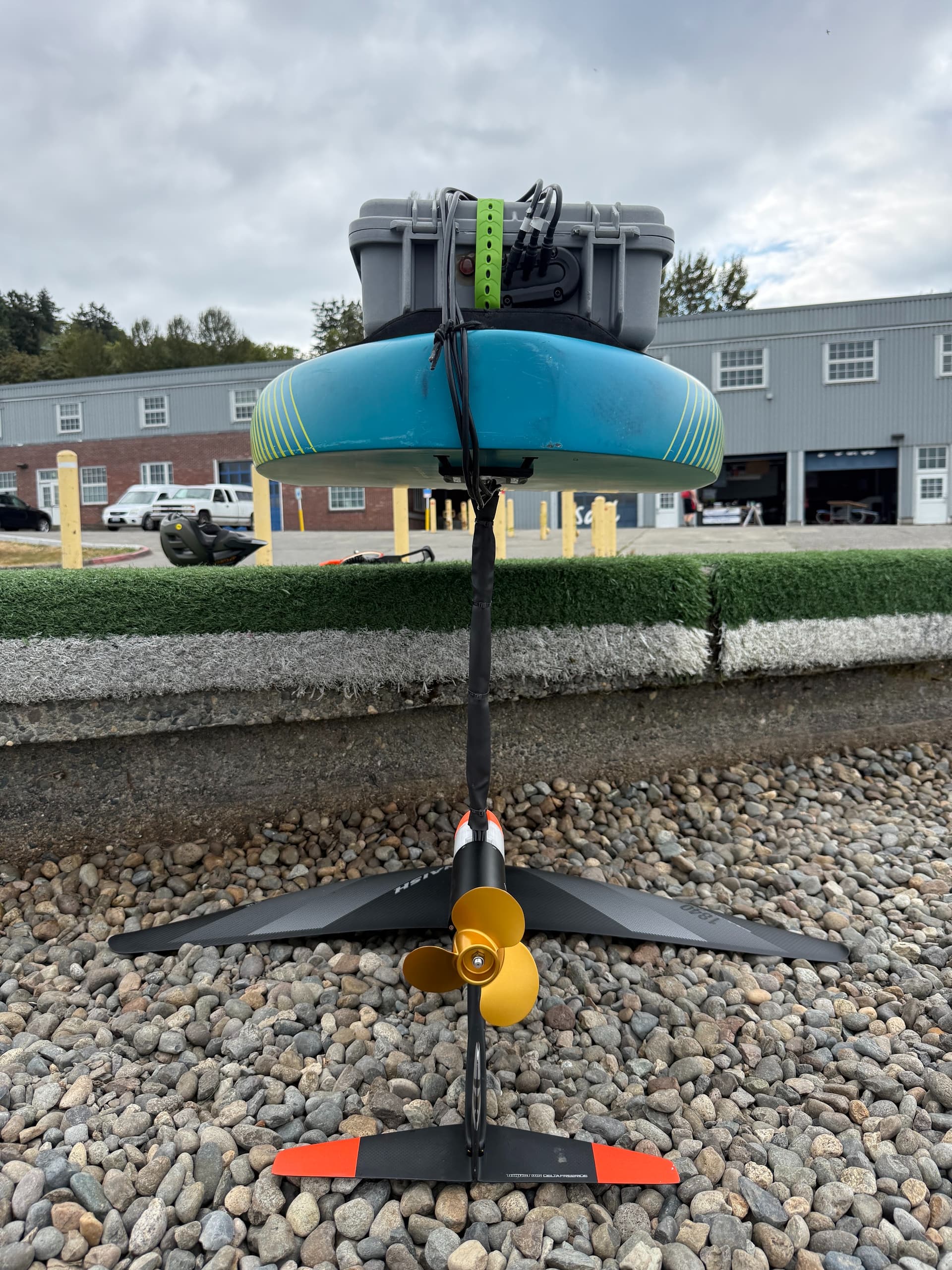
Looking down the fuselage. Naish Jet HA 1840 front wing, Flipsky 65161 on the mast with the prop between the wings, and the original Thrust WS Delta Freeride stabilizer with its vertical fin at the tail.
What happened in the 2026 tests
| On the water | In the logs | |
|---|---|---|
| Jul 21 | Three pops onto foil, ~3 s each, at 25.5 / 27.6 / 22.1 km/h, with nasty propulsion jolts. | Still on Duty No-Reverse; twice slammed into the old 154 A limit as revs collapsed. Rebuilt afterwards to Current No-Reverse, 0.8 s ramp, 120 A motor / 90 A battery |
| Aug 19 | No jolts, no cutouts, and I stood and rode repeatedly for the first time. | Current control did exactly what it was meant to do |
| Sep 1 | An hour out, repeatedly 15–20 km/h, endless brief lifts, up and down like a dolphin. | Peaks 90.6 A, 2.99 kW, 13,025 eRPM, 47.4 °C, 42.9 V minimum loaded — nothing near a limit except duty, pinned at 95%. Twice current dumped 74 → 20 A while revs ran 8,970 → 11,590 and boat speed bled off: the prop ventilating, then re-wetting |
So the system is voltage-limited, not current-starved, which is why 70% and 100% trigger felt identical. More amps are not the answer. Two caveats I still can’t resolve: motor-temperature sensing is disabled (the sensor reads open, so there is no thermal protection), and the VESC CSV doesn’t log raw PPM, so I can’t fully separate ventilation from my own trigger finger.
An aside on logging and water
I am still logging through the stock VESC BLE module and the VESC Tool phone app. It works, but my kill switch is mechanical and cuts power to the entire ESC, which drops the Bluetooth link. It does not reconnect on its own. So every time I come off the board I have to fish out the phone, reconnect, and restart logging by hand. An hour on the water becomes a handful of disconnected fragments, and the interesting moments have a talent for landing in the gaps — on September 1, about 17 minutes of dense telemetry covers roughly an hour of riding.
The fix was supposed to be a Voyage Minnie, which logs to onboard flash over CAN and doesn’t care whether a phone is listening. I bought one and it appears to have drowned almost immediately — it stopped connecting after its first real session. So I’m back on the BLE module.
Which brings me to the other running theme of this build: the box leaks. Constantly. I have redone the cable entries more times than I want to admit and I still find water sloshing around in there after most sessions. Somehow the ESC and the packs have shrugged this off for years, and the Minnie is the only thing it has actually killed. I’m well aware that’s luck rather than engineering and may try to just get another Pelican case and redo the kill switch and ESC wire mounts cleanly.
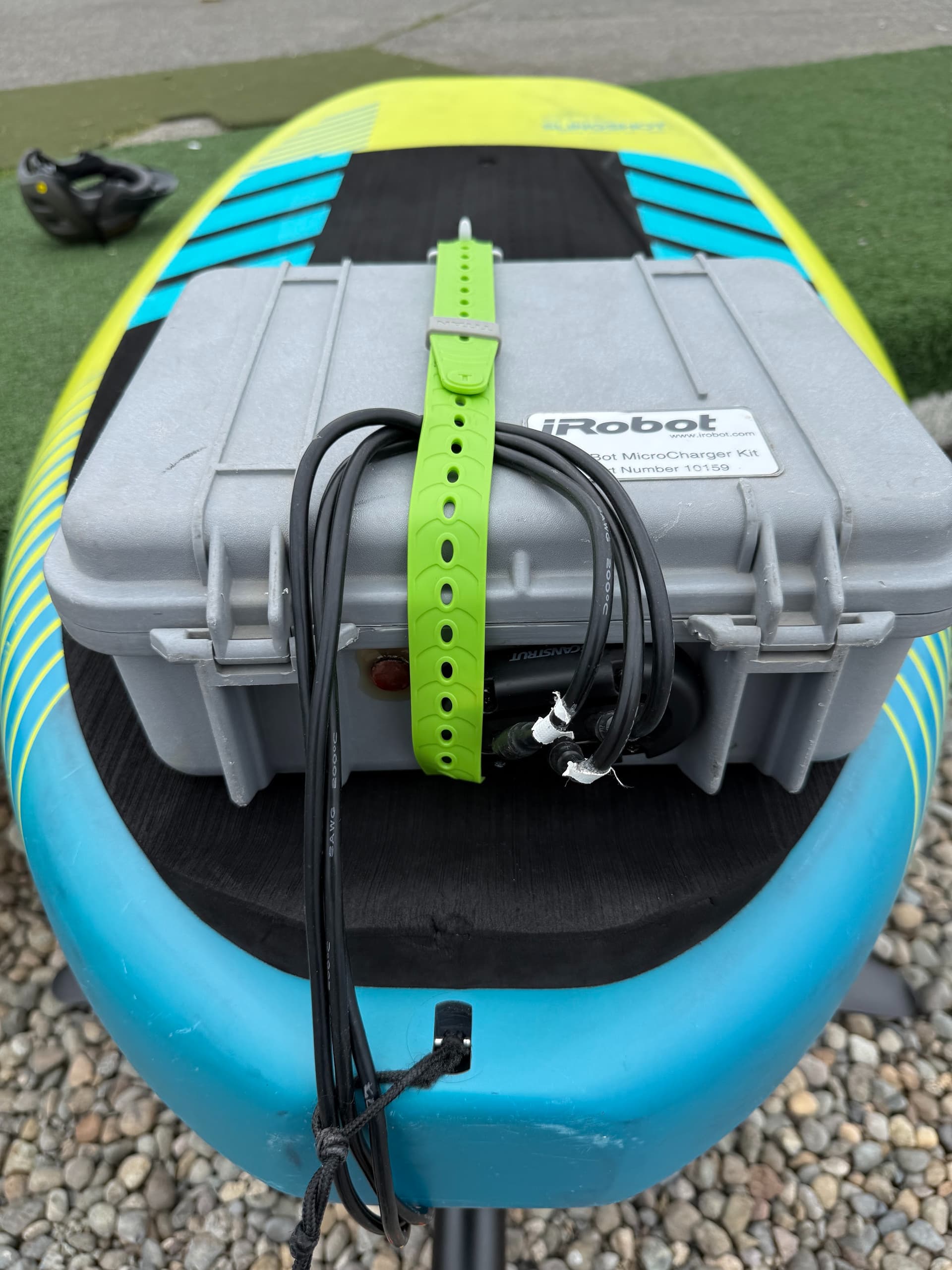
Could the vertical fin be the problem?
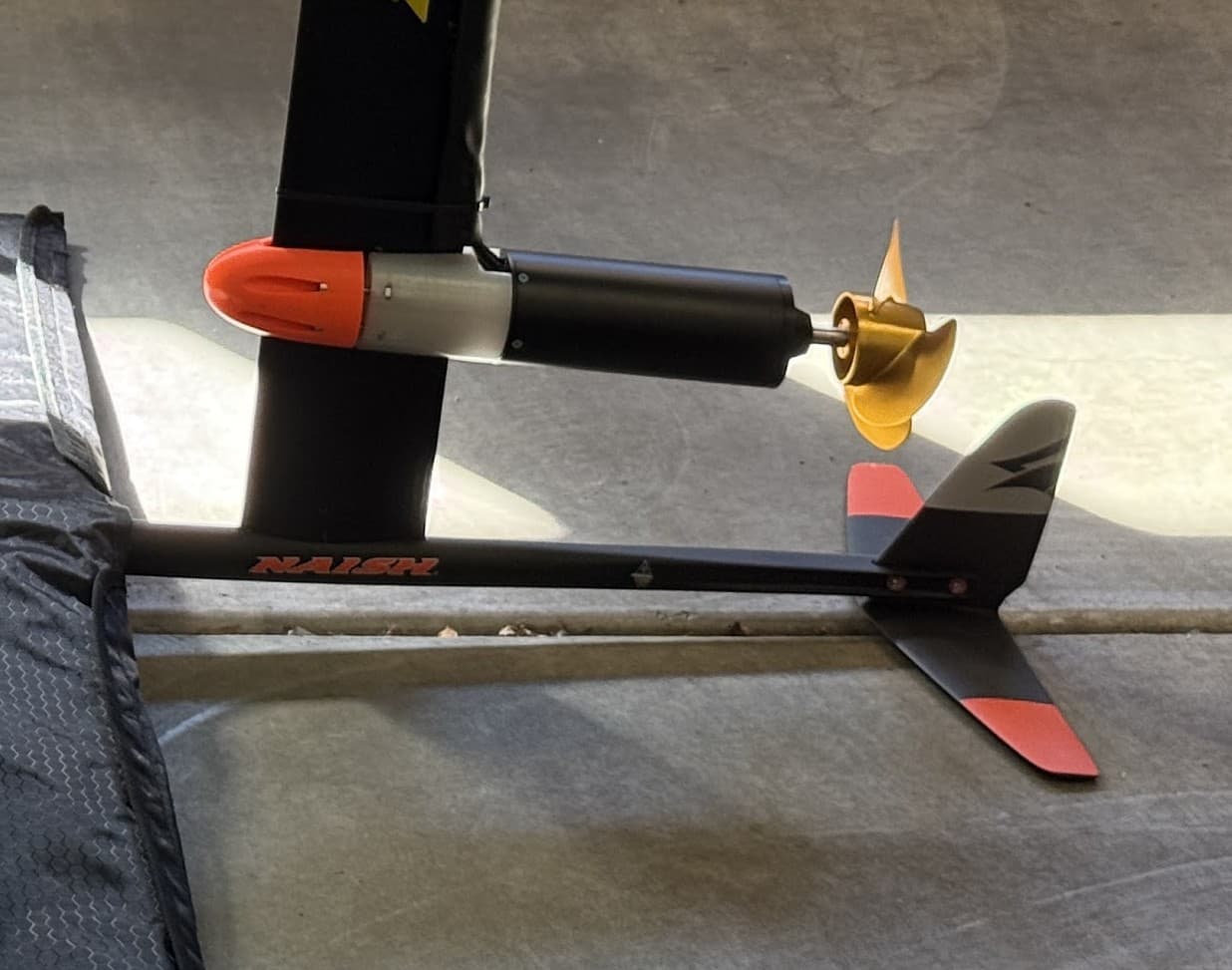
The observation that stuck with me this summer came from a chance encounter with an experienced efoil instructor who looked the rig over on the beach. He immediately flagged the vertical tail fin as odd for an efoil, specifically because it sits so close to the retrofitted motor and prop. That was a nice callback to my old thread: back in 2021, @kayak31 wondered exactly the same thing.
The fin is the original Naish back stabilizer, not something I added. On this 2018-era system it also forms the stabilizer mounting structure, with the adjustable stabilizer secured through it by horizontal cross-bolts, so I can’t simply cut it off without destroying the stabilizer mount.
Naish’s own answer to this was a small back-wing adapter that lets a modern finless stabilizer bolt to a 2018/2019 fuselage. It has been discontinued for years, so finding one has become its own little side quest. I would still rather go that route than buy a new fuselage, because the motor is mounted to the old mast — a newer fuselage would probably drag a new mast and a redesigned motor mount along with it, and then I have to redesign a motor mount.
What’s next?
My next meaningful A/B test is a complete finless rear-wing assembly, probably an S26 Jet 320 or HA 310, while leaving the electrical limits and front wing unchanged. I also plan to establish a repeatable trim baseline: verify that the current adjustable tail is exactly neutral and cannot slip, then move the mast 15–20 mm back from its nearly full-forward track position.
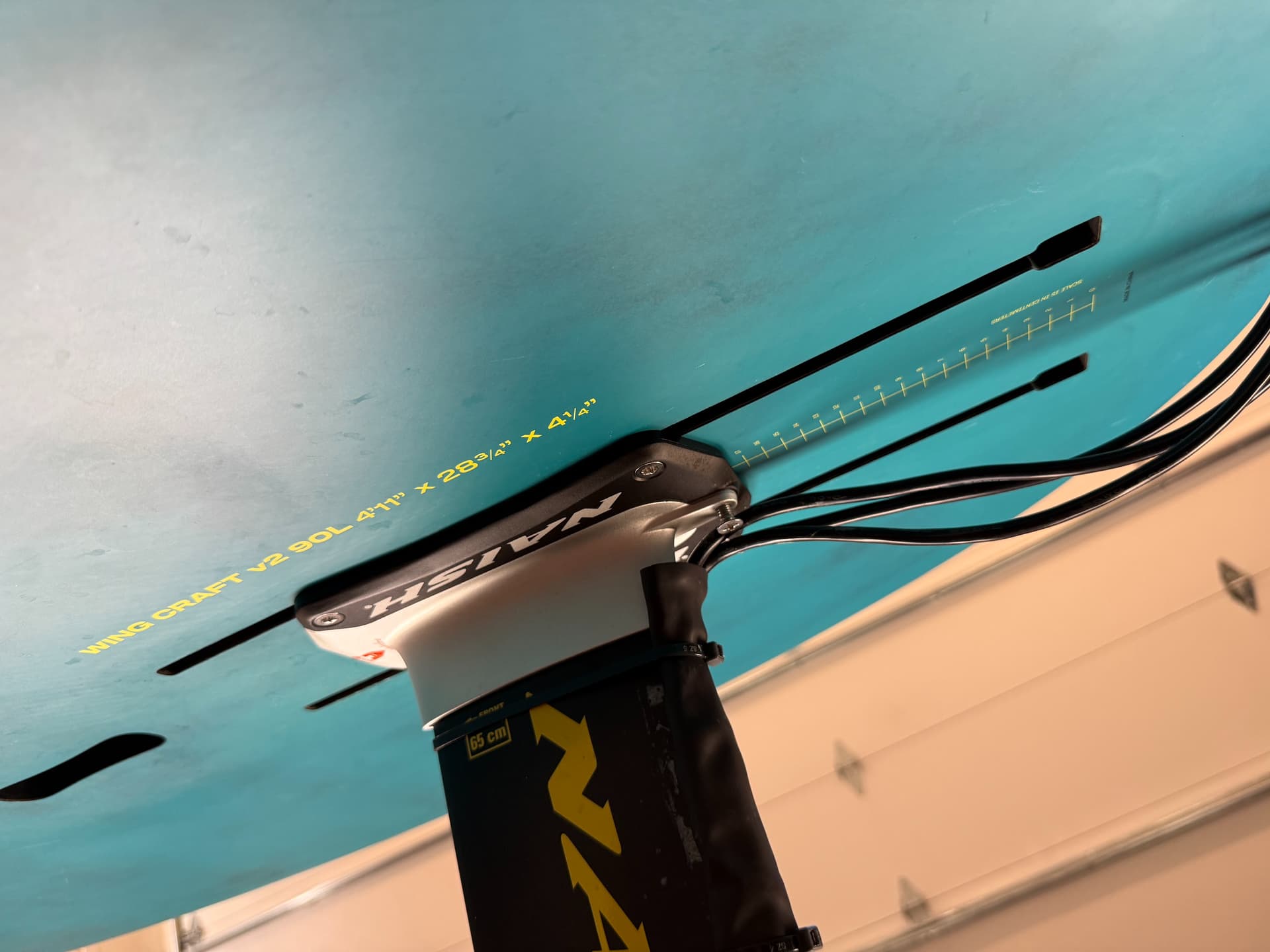
The mast is sitting well forward in the tracks. The board has a centimetre scale printed alongside the box, so the trim change is at least measurable and repeatable.
The main conclusions so far are:
- The system has enough power and front-wing lift to fly.
- Current control fixed most of the ugly propulsion behavior caused by duty control.
- More current is not the obvious answer; the system already reaches 95% duty with healthy voltage.
- Propeller ventilation and pitch trim are now the leading mechanical problems.
- The original vertical fin may be disturbing propeller flow, but I need a controlled finless-tail test to establish that.
So that is where it sits after four years: a board that will fly for a second or two at a time, a control system I finally trust, and one last piece of 2019 hardware to replace before I find out whether that fin was the problem all along. The rest is my own skills issues!